Custom Launch Images with Storyboards since iOS 8


Earlier this week, tweets from Nick Lockwood and James Thomson alerted me to an as yet undocumented new feature in the iOS 8 SDK: you can now use a storyboard scene in place of your app’s launch images.

Creating a Launch Screen File
The launch screen file is displayed as a splash screen while your app is launching. It’s a single, atomic .xib file that uses size classes to support different device resolutions. It contains basic UIKit views, such as UIImageView and UILabel objects, and uses Auto Layout constraints. Xcode adds a default launch screen file, called LaunchScreen.xib, to your project.

Follow these guidelines when creating a launch screen file:

  • Use only UIKit classes.
  • Use a single root view that is a UIView or UIViewController object.
  • Don’t make any connections to your code (don’t add actions or outlets).
  • Don’t add UIWebView objects.
  • Don’t use any custom classes.
  • Don’t use runtime attributes.

You can add a launch screen file to an older Xcode project.

To create a launch screen file for an existing project

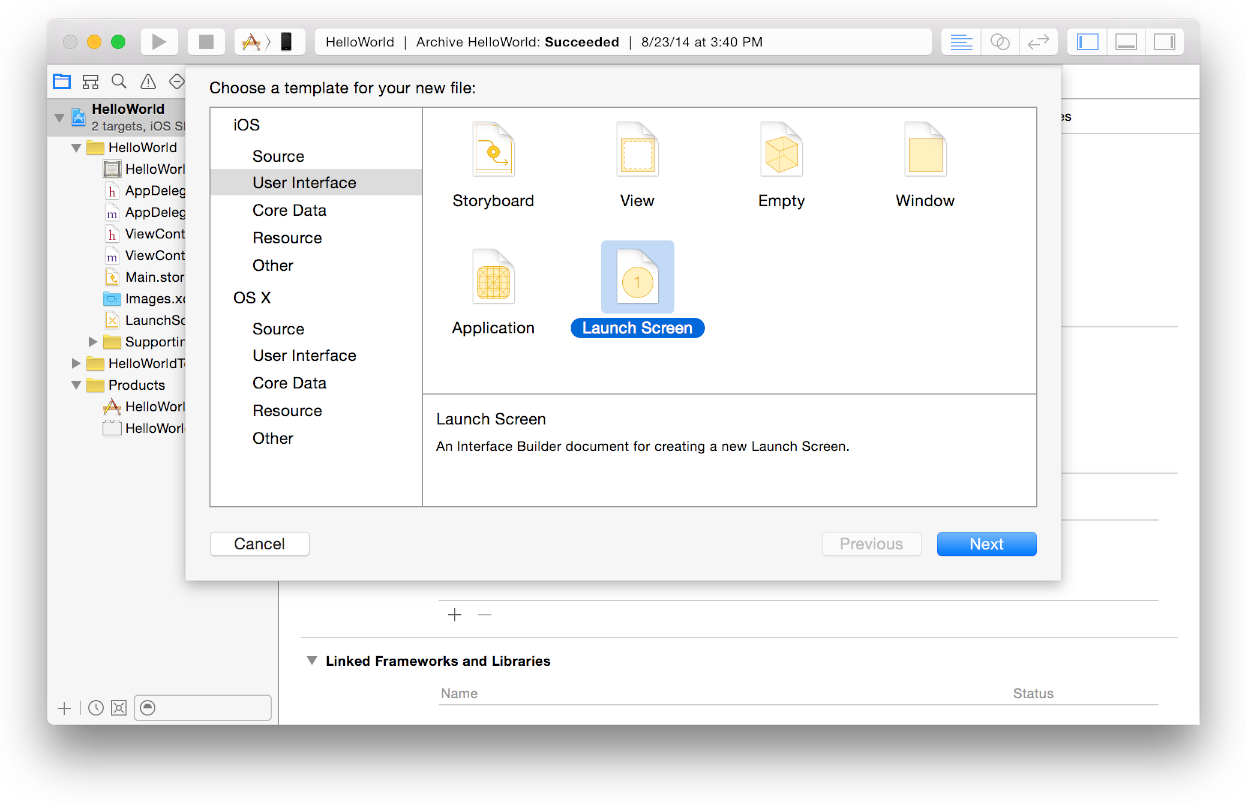
Choose File > New > File.
Under iOS, select User Interface.
Select Launch Screen and click Next.
../Art/3_create_launch_screen_file_2x.png
Enter a file name in the Save As text field and click Create.
To set the launch screen file

In necessary, open the “App Icons and Launch Images” section of the General pane
From the Launch Screen File pop-up menu, choose a launch screen file.

Apple Developer
oleb.net

Comments

Most Favorite Posts

Google Drive versus Dropbox

MacWorld: Online Storage Face-Off: Google Drive vs. Dropbox

j2obc - A Java to iOS Objective-C translation tool and runtime

What J2ObjC Is J2ObjC is an open-source command-line tool from Google that translates Java code to Objective-C for the iOS (iPhone/iPad) platform. This tool enables Java code to be part of an iOS application's build, as no editing of the generated files is necessary. The goal is to write an app's non-UI code (such as data access, or application logic) in Java, which is then shared by web apps (using GWT), Android apps, and iOS apps. J2ObjC supports most Java language and runtime features required by client-side application developers, including exceptions, inner and anonymous classes, generic types, threads and reflection. JUnit test translation and execution is also supported. J2ObjC is currently between alpha and beta quality. Several Google projects rely on it, but when new projects first start working with it, they usually find new bugs to be fixed. Apparently every Java developer has a slightly different way of using Java, and the tool hasn't translated all possib...

Server-driven UI (SDUI): Meet Zalandos AppCraft and AirBnB Lona

A short WTF: Joe Birch:  SERVER DRIVEN UI, PART 1: THE CONCEPT Zalando seems to follow the SDUI principle as well - defining a common design language and construct the screens on the backend while displaying them natively on the clients. They even go one step further; they implemented a mighty toolset to enable non-technical stakeholders to define their own native app screens Compass: Web tooling to create screens and bind data Beetroot: Backend service that combines the screen layout definition with the data Lapis/Golem: iOS/Android UI render engines Crazy cool! Good job, guys (when you do an open-source release?) To even move faster a Flutter based UI render engine implementation was great! See also AirBnB Lona SDUI approach Building a Visual Language Why Dropbox sunsetted its universal C++ mobile project and AirBnB its React Native implementation

CFPropertyList

The PHP implementation of Apple's PropertyList plist can handle XML PropertyLists as well as binary PropertyLists. It offers functionality to easily convert data between worlds, e.g. recalculating timestamps from unix epoch to apple epoch and vice versa. A feature to automagically create (guess) the plist structure from a normal PHP data structure will help you dump your data to plist in no time. github

CloudApp

CloudApp allows you to share images, links, music, videos and files. Here is how it works: choose a file, drag it to the menubar and let us take care of the rest. We provide you with a short link automatically copied to your clipboard that you can use to share your upload with co-workers and friends. Additionally you can view, track and delete files right from your menubar. CloudApp

PlistBuddy

If you want to generate a Plist within the shell script: The PlistBuddy command is used to read and modify values inside of a plist. Unless specified by the -c switch, PlistBuddy runs in interactive mode. Apple PlistBuddy ManPage

App Indexing

A better search experience for apps and users with linking to in-app content. Google is working with app developers and webmasters to index the content of apps and relate them to websites. When relevant, Google Search results on Android will include deep links to apps. App Indexing